
In the world of communications and marketing, the multiplicity of available channels and formats can be both a great opportunity and a navigational challenge. The coherent integration of all these channels is essential to reach audiences effectively, measure results, and optimize investments. It is in this context that the PESO model — Paid, Earned, Shared, and Owned Media — emerges as a conceptual framework that guides strategic decision-making and operational execution in communications.
PESO was popularized by Gini Dietrich, an author and public relations expert, as a tool for planning and measuring campaigns holistically, considering both paid and unpaid media, and ensuring that the strategy remains focused on objectives and the target audience.
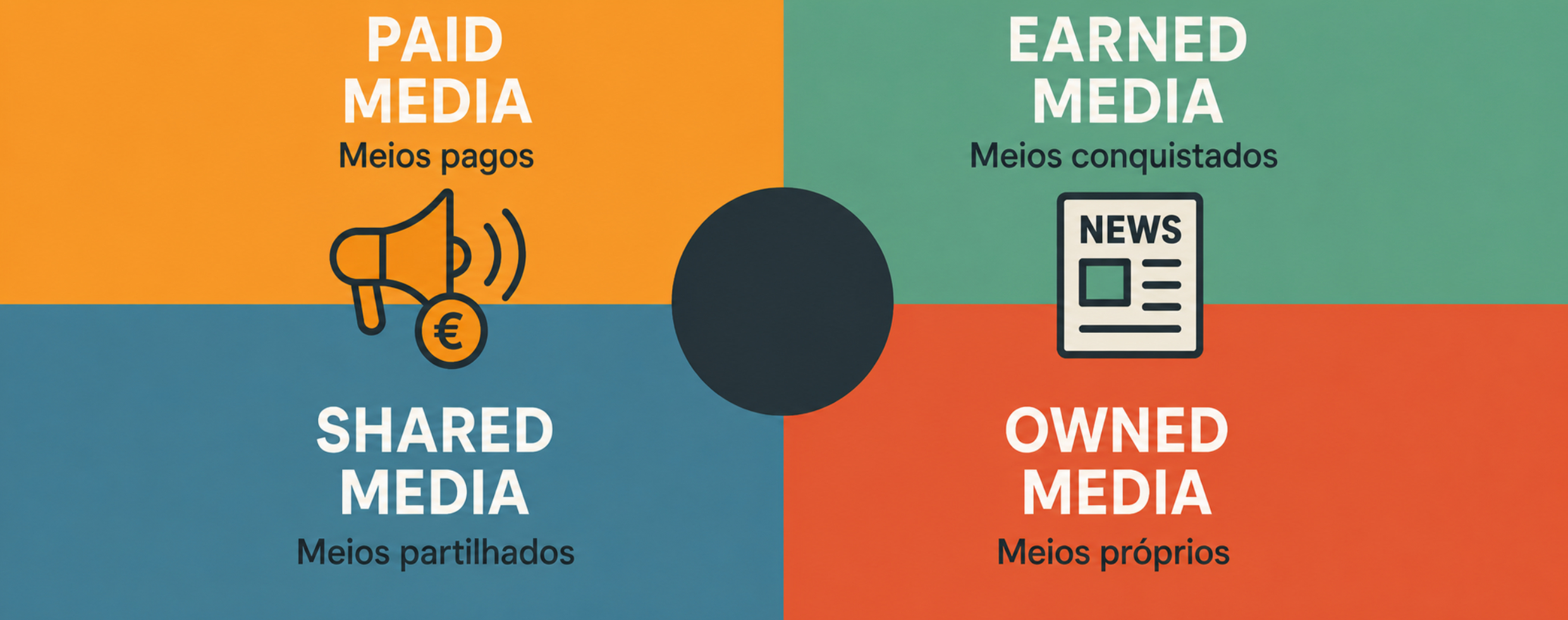
The acronym PESO describes four types of communication channels:
-
Paid Media: Includes all purchased advertising space, such as digital ads, billboards, radio spots, sponsored social media campaigns, or paid influencers. The goal is to quickly expand reach and drive traffic or awareness.
-
Earned Media: Refers to spontaneous media coverage — press articles, unpaid influencer mentions, organic shares, and third-party endorsements. This type of media is earned through public relations, media outreach, and credibility.
-
Shared Media: Encompasses content that circulates across social networks and online communities, shared by users, partners, or brand fans. Its value lies in reach and social proof.
-
Owned Media: Includes all channels that the organization directly controls, such as websites, blogs, newsletters, podcasts, or proprietary applications. These are long-term strategic assets where the brand has full autonomy over the content.
The strength of the PESO model lies in its ability to:
-
Provide an integrated view: Instead of treating each channel in isolation, it allows for crafting a coherent narrative across different media.
-
Maximize synergies: For example, a blog post (Owned) can be promoted via ads (Paid), shared on social media (Shared), and generate press coverage (Earned).
-
Measure results clearly: The framework makes it easier to assign specific metrics to each media type and calculate return on investment (ROI).
-
Optimize resources: It helps decide where to invest more time, budget, and energy according to the organization’s objectives.
Gini Dietrich, creator of the concept, emphasizes that “the PESO model is not a rigid recipe, but a living framework that adapts to each organization and market.” James Grunig, a leading public relations scholar, highlights that communication effectiveness stems from combining consistent messaging with diversified channels tailored to the target audience.
According to the Chartered Institute of Public Relations (CIPR), applying PESO “allows communication professionals to align marketing, PR, and advertising efforts, avoiding redundancies and maximizing efficiency.”
The PESO model is more than a conceptual diagram; it is a roadmap for navigating the complexity of contemporary communications. By strategically integrating Paid, Earned, Shared, and Owned Media, organizations can amplify messaging, build credibility, and consistently measure results.
For companies and institutions—especially those without robust marketing departments—PESO offers a common language and a practical guide. By applying this framework with clear goals, cross-team coordination, and careful attention to metrics, it is possible to transform fragmented campaigns into solid strategies with a tangible impact on business and reputation.
Paulo Fidalgo
CEO of Marketividade