
Economic growth in a country is a discrete yet virtuous lever that pulls upward the income levels and well-being prospects of the majority of the population, most notably among disadvantaged brackets.
Conversely, economic depression installs a negative vertigo of value losses that only the very privileged manage to resist, most often shielded from reality by leonine public contracts or assets of strategic value.
There is therefore every reason to applaud a country that has rebelled against crisis by using intelligence and labor to overcome difficulties and recover a trajectory of optimism.
However, it is important to show with transparency and real numbers that the country currently beating the crisis is not that of high-profile media entrepreneurs, ex-politicians turned entrepreneurs, and velvet-gloved swindlers with butlers.
Those actually creating value for themselves and for Portugal are the women and men without airs or prejudices who, driven by necessity and the ambition to improve their incomes, took on the risk of producing well and exporting better, against all the prognostications of stating-the-obvious commentators.
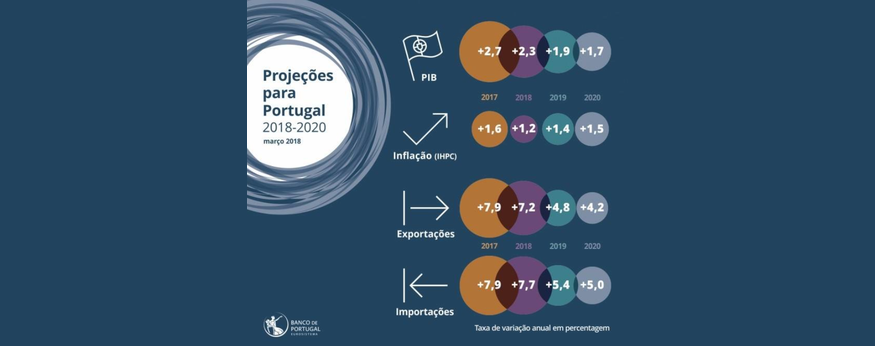
Yet amidst the shining lights, some signal alarm. The Bank of Portugal’s forecasts present a scenario of worrisome deceleration through 2020.
And it must be noted that the growth verified is currently above potential growth! To laypeople, this statement will seem like an aberration, but it carries a troubling technical meaning because it clearly illustrates the narrow limits of what we can achieve without deep alterations in the structure of the Portuguese economy.
Potential growth can be defined as the maximum growth an economy can attain without provoking an overheating of economic activity—that is, without generating inflationary pressures.
Potential growth is intimately linked to three factors: a country’s labor supply, capital reserves, and productivity.
If current growth is already exceeding the theoretical optimal combination of these variables, it becomes vital to know what we can and must do to move these fundamental growth factors.
Yet I do not see anyone willing to touch anything at all. Everyone seems quite happy with what they have and what they are. Now that is something that should terrify this country’s poorest.
Paulo Fidalgo
CEO of Marketividade